
What it is
Lumbar spondylosis is the medical name for wear-related change in the lower back: discs that have lost water and height, small bony spurs at the edges of the vertebrae, and thickened joints and ligaments behind them. Degenerative disc disease is the same finding under a different name, and an X-ray or MRI report may use either. Neither is a disease in the usual sense. They describe a spine that has been used for some decades, and they appear on the scans of most adults whether or not the back hurts [1]. In India the same report is very often read out as lumbar spondylitis. The two words are not the same. Spondylosis is wear. Spondylitis means inflammation of the spine, a different and much rarer group of conditions, and a report that says spondylosis is describing wear.
Low back pain itself is close to universal. In a meta-analysis of 97 Indian studies, 48% of people had low back pain at the time they were asked and 66% had had it at some point in their lives [5]. Worldwide it is the leading cause of disability, and for nearly all people who have it no single structure can be blamed with confidence [2]. Most new episodes settle quickly, recurrence is common, and a small proportion of people go on to persistent, disabling pain [2]. The wear on the scan and the pain in the back are only loosely connected, which is why this guide spends more time on what you can do than on what the report says.
How it presents
- A dull ache across the lower back, sometimes spreading into the buttocks or the top of the thighs, without a clear line of pain down the leg
- Stiffness first thing in the morning and after sitting still, which eases once you are up and moving
- Pain that builds with a long spell in one position, sitting, standing or bending over a task, and eases with a change of position
- Flares that come on with an awkward lift, a long journey or a heavy day, last days to a few weeks, and then settle
- Difficulty straightening up after bending, or a back that feels weak or unreliable rather than sharply painful
- Good spells and bad spells over years, rather than a steady decline
- Occasionally, pain that spreads below the knee, or legs that ache and tire on walking, which point to a nerve root or a narrowed canal rather than to the wear itself
Back-dominant pain, more back than leg, is the pattern this guide covers. Pain that travels down one leg in a line, with pins and needles or numbness, is a nerve root problem and follows a different course; our sciatica guide, at /conditions/sciatica/, covers it. Leg heaviness that comes on with walking and eases with sitting, in an older spine, points to a narrowed canal, which has its own route.
Who gets it and why
A lumbar disc is a fibrous ring around a gel-like centre that holds water. From early adulthood the centre slowly dries and the disc loses height. As it does, the small joints behind it and the edges of the vertebrae take more load and lay down extra bone, the spurs an X-ray shows, and the ligaments thicken. This is the process the report is describing, and it happens in everyone. Pain, when it comes, is more often the joints, muscles and ligaments of a back complaining about a load they are not conditioned for, with the wear as a bystander, than the wear itself hurting.
The scans of people with no pain make the point. In a systematic review of 33 studies covering 3110 people with no back symptoms at all, disc degeneration was present in 37% of 20-year-olds and 96% of 80-year-olds, and a disc bulge in 30% and 84% [1]. The authors' conclusion was that many of these features are part of normal ageing and unrelated to pain [1]. A report that says spondylosis, or degenerative disc disease, is describing your age group. It is not a prognosis, and it is not a reason to stop bending.
Risk factors
- Age. Disc degeneration on scans rises from 37% of 20-year-olds to 96% of 80-year-olds [1], though pain does not rise in step with it
- Physically demanding work. In India the pooled prevalence of low back pain was highest among elementary workers, women and people in rural areas [5]
- Smoking and obesity, both of which raise the risk of reporting low back pain [2]
- Other health conditions alongside, physical or mental, which raise the risk of low back pain [2]
- A previous episode, since recurrence is common [2]
- Long hours in one position, at a desk or a steering wheel, which do not cause the wear but are a reliable trigger for the pain
How it is diagnosed
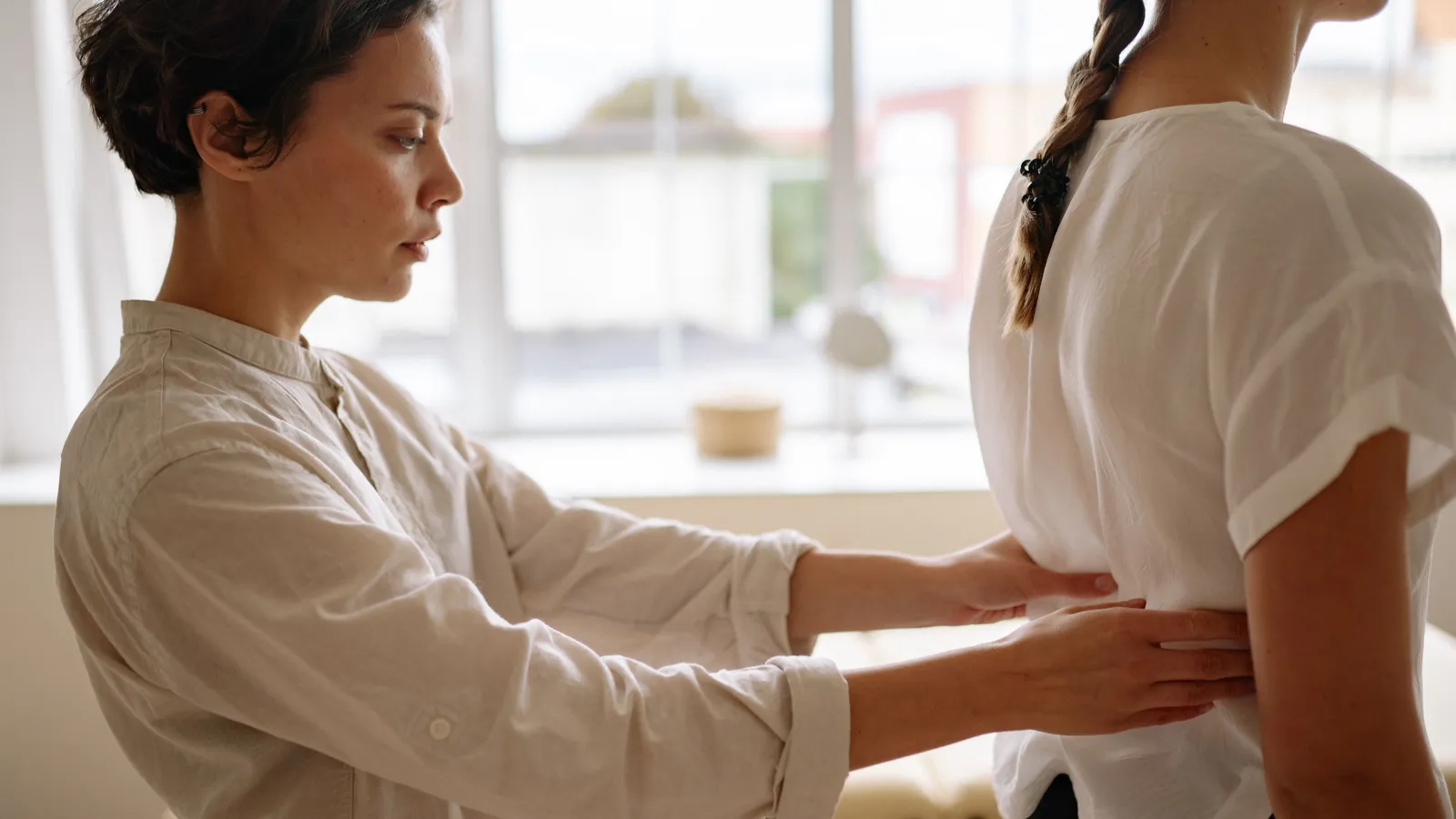
The diagnosis is made in the room, and its first job is to sort the pain into one of three groups. The first is back pain with no specific cause that can be found, which is nearly everyone [2]. The second is pain from a nerve root or a narrowed canal, which brings leg symptoms. The third is the small group with a serious cause, a fracture, an infection or a cancer, which the questions and examination are designed to catch [2]. Then the examination adds what a scan cannot: how the back moves and which directions provoke or ease the pain, how the hips move, how strong and enduring the trunk and hip muscles are, and a check of the nerves in the legs. That, not the report, decides the plan.
Imaging does not improve the outcome of ordinary low back pain. In a meta-analysis of six randomised trials with 1804 patients, people sent for an immediate X-ray, CT or MRI did no better in pain or function than people treated without one, either in the first three months or at six months to a year [7]. NICE advises against routine imaging outside a specialist setting, and reserves it for cases where the result is likely to change management [4]. The reason is the review above: a scan will show wear in most adults, painful or not [1], and a report full of alarming words can do harm of its own, by making a person guard a back that needs to move.
When imaging earns its place
A scan earns its place when the picture does not fit: leg symptoms with weakness or numbness that are not settling, pain that is not clearly improving after a proper course of treatment, or an injection or surgery being considered. It is urgent, not routine, when there are signs of a serious cause. Numbness in the saddle area or a change in bladder or bowel control needs same-day assessment and usually an emergency MRI, because a large central disc can compress the nerves at the base of the spine, and the outcome depends on how quickly it is decompressed [14]. Pain after a significant fall, or in someone with osteoporosis or on long-term steroids, needs a fracture excluded. Fever, unexplained weight loss or a history of cancer needs a doctor's assessment, and often blood tests and a scan [2].
What the evidence says
Treatment by treatment, with the studies behind each verdict numbered to the sources at the end of the page.
Staying active
Core treatmentThe oldest finding in back pain, and still the most useful. The Cochrane review of advice to rest in bed against advice to stay active found small but real benefits in pain and function from staying active in acute low back pain, across two trials with 401 people [8]. NICE advises people to continue normal activities as far as possible [4]. Bed rest weakens the muscles the spine depends on, and it teaches the back that movement is dangerous, which is the belief that turns an episode into a problem.
Exercise therapy
Core treatmentFor pain that has lasted more than three months, the current Cochrane review pools 249 trials. Against no treatment, usual care or placebo, exercise reduced pain by about 15 points on a 100-point scale, a difference the authors judged clinically important, and improved function by about 7 [9]. Exercise probably did better than advice or education alone and than electrotherapy, and matched manual therapy; the harms reported were mostly muscle soreness [9]. The type of exercise matters less than the dose, and the months it is kept up.
Understanding what the report means
Core treatmentGuidelines put education that supports self-management and a return to normal activity first, ahead of any tablet or procedure [3]. In the Norwegian fusion trial, the non-surgical arm was a lecture explaining that ordinary activity would not harm the disc, a recommendation to use the back and bend it, and three weeks of exercise, and it matched spinal fusion at one year [12]. Education by itself does less than exercise does, by about 12 points on the pain scale in the Cochrane review [9]. Its job is to make the exercise possible, by removing the fear that stops people doing it.
Hands-on treatment
Helps alongsideSpinal mobilisation and manipulation produced results similar to the other recommended treatments for chronic low back pain in a review of 47 trials with 9211 people, with a small extra benefit in function in the short term [10]. The Cochrane exercise review found no difference between exercise and manual therapy [9]. NICE recommends it only as part of a package that includes exercise [4]. That is how we use it: to reduce pain and guarding enough to get the programme going. Side effects are usually a short-lived increase in soreness [10].
Pain relief
Helps alongsideNICE suggests an oral anti-inflammatory at the lowest effective dose for the shortest time, with stomach, kidney and heart risks weighed. It advises against paracetamol on its own, against opioids for chronic low back pain, and against antidepressants and anticonvulsants, the family that includes gabapentin and pregabalin, for back pain [4]. A short course that makes movement and sleep possible is worth having. A tablet that lets you avoid moving is not.
A psychologically informed programme
Helps alongsideFor pain that has become persistent, guidelines recommend adding a psychological programme, usually cognitive behavioural work delivered alongside exercise, for people whose recovery is being held back by fear, low mood or the belief that the back is damaged [3][4]. The wear on the scan is itself one of those beliefs, and undoing it is part of every session here. This is not a suggestion that the pain is imagined. It is a recognition that how a person thinks about their back changes what they do with it [2].
Acupuncture, TENS, ultrasound and traction
AvoidNICE looked at each and recommends against all of them for low back pain: acupuncture, ultrasound, interferential therapy, TENS and traction [4]. The Cochrane exercise review found exercise more effective than electrotherapy [9]. None of them is dangerous. They use up sessions and money that the programme needs, and they keep the person on the couch when the evidence says they should be moving.
Facet joint injections and radiofrequency denervation
AvoidNICE advises against spinal injections for low back pain, and allows radiofrequency denervation, in which the small nerves to the facet joints are heated, only for people with moderate to severe pain that reproduces from those joints on a diagnostic block [4]. The MINT trials then tested exactly that group: 681 people with a positive block, all given a three-month exercise programme, half also given denervation [11]. At three months the extra benefit of denervation was between 0.2 and 1 point on a 10-point pain scale, below the 2 points set in advance as the smallest difference worth having, and the authors concluded that the findings do not support its use [11].
Spinal fusion for degenerative disc disease
AvoidThe operation most often offered for the label. In the Norwegian trial, 64 people with more than a year of back pain and disc degeneration on X-ray were randomised to fusion or to the programme of understanding and exercise above. Disability fell from 41 to 26 on a 100-point scale after surgery and from 42 to 30 after the programme, a difference that was not significant, and the surgical group had an 18% early complication rate [12]. At an average of 11 years after treatment, follow-up of 473 people across three such trials found no difference between fusion and rehabilitation, and the authors concluded that fusion should not be favoured where rehabilitation is available [13]. NICE advises against fusion for low back pain outside a trial [4].
Bed rest, belts and corsets
AvoidBeyond a day or two of the worst pain, bed rest does not help and it weakens everything that supports the spine [8]. NICE also advises against belts, corsets, foot orthotics and rocker-soled shoes for low back pain [4]. A belt worn for a heavy day is a habit we can discuss; a belt worn every day is a muscle that has been given the day off.
Read as a whole, the evidence points away from the scan and towards the back. Keep moving, understand what the report does and does not mean, calm the worst week with hands-on treatment and a short course of sensible pain relief, then build a trunk and hips that can carry a working day and keep them that way [3][4][9]. Procedures aimed at the wear itself, injections, denervation and fusion, have been tested against structured rehabilitation and did not beat it [11][13]. The Lancet series put it plainly: worldwide, the gap in back pain care is too little of the first-line treatments and too much imaging, rest, opioids, injections and surgery [3].
How we treat it
At The Rym Space, Bagalur
- 1
Assessment
The story, then how your back moves and which directions ease or provoke it, how the hips move, how strong the trunk and hip muscles are, and a check of the nerves in the legs. You leave knowing which group your pain belongs to and what your report actually says.
- 2
A plan you start that day
The movements that ease the back, done little and often. How to sit, get out of a chair and a car, lift and sleep without provoking it. Straight talk about pain relief, and about the words on the scan in plain language, so they stop frightening you.
- 3
Week 1: settle the pain
3 to 5 sessions close together. Hands-on treatment to calm pain and guarding, the easing movements made a habit, and a few basic exercises to repeat through the day. Walking is the main activity, and the aim of the week is a back calm enough to be trained.
- 4
Week 2 onwards: build strength
Progressive strengthening for the trunk, hips and legs: hip hinges, squats, bridges and carrying, loaded a little more each week. Sessions space out as the home programme carries the work, and the working day is rebuilt in steps, with more sitting, more bending and a longer walk.
- 5
Months 2 to 3: make it yours
Loading taken up to what you want back: lifting, floor sitting, a long journey, the gym or the field. The programme is trimmed to a short routine you can run alone a few times a week, and you learn how to handle a flare without stopping everything.
- 6
Discharge, or the next tier
Done when pain is manageable, function is back and you know what to do when it grumbles. Pain not clearly improving after a proper course, or any leg weakness, means medical review and a scan rather than more of the same, and we will say so.
What to expect, and when
Ranges, not promises. Where a figure comes from a study, the study is numbered.
- First 6 weeks
- The steepest improvement. In a meta-analysis of 33 cohorts with 11,166 people, average pain in a new episode fell from 52 to 23 on a 100-point scale by six weeks [6]. Much of that is the natural course. The job now is to keep moving and to find the positions and movements that ease it.
- By 3 to 6 months
- Improvement continues but slows. Pain in the new-episode cohorts averaged 12 out of 100 at six months [6]. The strength that keeps it there is only starting to build by now, which is why the programme carries on past the point where the pain has mostly gone.
- By 12 months
- In the same analysis, average pain was 6 out of 100 at one year for people whose episode had been new, and 23 for those whose pain was already persistent when they were first seen [6]. That second figure is the case for starting properly rather than waiting.
- The years after
- Recurrence is common, and a small proportion of people go on to persistent, disabling pain [2]. The wear on the scan increases with age in everyone [1]; the pain does not have to. The aim is a back that recovers quickly when it grumbles, and the strength work is what makes that likely.
Pain and strength move on different clocks. Pain usually eases within weeks, from movement, understanding and hands-on treatment; the strength that keeps it eased takes months of training, which is why people who stop at week four conclude that exercise did not work. A flare is not the spondylosis progressing. It is a back that has been asked for more than it was conditioned for, and it usually settles the way the first episode did.
When to be seen sooner
Signs that this is something else, or that it needs looking at now rather than after a few weeks of self-care.
- Numbness or altered sensation in the saddle area: the inner thighs, groin, buttocks or around the back passage. Same-day assessment, because a large central disc can compress the nerves at the base of the spine and the outcome depends on speed [14]
- Any new difficulty passing urine, loss of control of bladder or bowel, or loss of sensation when you go [14]
- Weakness in a leg or foot, symptoms in both legs, or a foot that drags or slaps when you walk
- Back pain after a fall or accident, or a new, sudden pain in someone with osteoporosis or on long-term steroids, until a fracture is excluded
- Fever or feeling unwell alongside the back pain, or a recent infection, which needs an infection in the spine excluded
- Pain that is constant, worse at night and unrelated to movement, unexplained weight loss, or a history of cancer [2]
- Pain that has not begun to improve after six to eight weeks of treatment, which changes the plan rather than the urgency
Common questions
- My report says lumbar spondylosis with degenerative disc disease. How bad is that?
- It says your spine looks its age. In the review of scans of people with no back pain at all, disc degeneration was present in 37% of 20-year-olds and 96% of 80-year-olds [1]. The report tells us what the spine looks like. The examination tells us why it hurts and what to do about it.
- Is spondylosis the same as spondylitis?
- No, though in India the words are often swapped. Spondylosis is wear-related change and is what a report almost always means. Spondylitis means inflammation of the spine, as in ankylosing spondylitis, a separate condition that tends to start in younger adults, with stiffness that is worse at night and in the morning and eases with movement, and it needs a rheumatologist. A report that says spondylosis is describing wear.
- Do I need an MRI?
- Not to start treatment. In six trials with 1804 people, immediate imaging made no difference to pain or function in the short term or at six months to a year [7], and NICE advises against routine imaging [4]. We ask for one when there are leg symptoms with weakness, when a proper course of treatment has not worked, or when an injection or surgery is on the table, and urgently if there are signs of a serious cause.
- Should I rest until it settles?
- No. Advice to stay active gave better pain and function than advice to rest in bed in the Cochrane review [8], and NICE says to continue normal activities as far as possible [4]. Change position often, walk, and let the assessment find the movements that ease it.
- Will I need surgery?
- Very unlikely, for back-dominant pain. Fusion for degenerative disc disease was tested against a programme of understanding and exercise and did no better at one year [12] or at an average of 11 years [13]. Surgery has a place for a nerve that is losing function or for the rare serious causes, not for wear on a report.
- Will it get worse as I get older?
- The wear on the scan increases with age in everyone [1]; the pain does not have to. Most new episodes settle quickly, and although recurrence is common, only a small proportion of people go on to persistent, disabling pain [2]. A back that is kept moving and strong copes with more wear, not less. Flares will happen. The aim is a back that recovers quickly from them.
Further reading
Sources
Guidelines, systematic reviews and trials only. Each number in the text links to the entry here.
- 1.Brinjikji W, Luetmer PH, Comstock B, et al. Systematic literature review of imaging features of spinal degeneration in asymptomatic populations. AJNR Am J Neuroradiol. 2015;36(4):811-816. pubmed.ncbi.nlm.nih.gov ↗
- 2.Hartvigsen J, Hancock MJ, Kongsted A, et al. What low back pain is and why we need to pay attention. Lancet. 2018;391(10137):2356-2367. pubmed.ncbi.nlm.nih.gov ↗
- 3.Foster NE, Anema JR, Cherkin D, et al. Prevention and treatment of low back pain: evidence, challenges, and promising directions. Lancet. 2018;391(10137):2368-2383. pubmed.ncbi.nlm.nih.gov ↗
- 4.Bernstein IA, Malik Q, Carville S, Ward S. Low back pain and sciatica: summary of NICE guidance. BMJ. 2017;356:i6748. pubmed.ncbi.nlm.nih.gov ↗
- 5.Shetty GM, Jain S, Thakur H, Khanna K. Prevalence of low back pain in India: a systematic review and meta-analysis. Work. 2022;73(2):429-452. pubmed.ncbi.nlm.nih.gov ↗
- 6.da C Menezes Costa L, Maher CG, Hancock MJ, McAuley JH, Herbert RD, Costa LO. The prognosis of acute and persistent low-back pain: a meta-analysis. CMAJ. 2012;184(11):E613-E624. pubmed.ncbi.nlm.nih.gov ↗
- 7.Chou R, Fu R, Carrino JA, Deyo RA. Imaging strategies for low-back pain: systematic review and meta-analysis. Lancet. 2009;373(9662):463-472. pubmed.ncbi.nlm.nih.gov ↗
- 8.Dahm KT, Brurberg KG, Jamtvedt G, Hagen KB. Advice to rest in bed versus advice to stay active for acute low-back pain and sciatica. Cochrane Database Syst Rev. 2010;6:CD007612. pubmed.ncbi.nlm.nih.gov ↗
- 9.Hayden JA, Ellis J, Ogilvie R, Malmivaara A, van Tulder MW. Exercise therapy for chronic low back pain. Cochrane Database Syst Rev. 2021;9:CD009790. pubmed.ncbi.nlm.nih.gov ↗
- 10.Rubinstein SM, de Zoete A, van Middelkoop M, Assendelft WJJ, de Boer MR, van Tulder MW. Benefits and harms of spinal manipulative therapy for the treatment of chronic low back pain: systematic review and meta-analysis of randomised controlled trials. BMJ. 2019;364:l689. pubmed.ncbi.nlm.nih.gov ↗
- 11.Juch JNS, Maas ET, Ostelo RWJG, et al. Effect of radiofrequency denervation on pain intensity among patients with chronic low back pain: the Mint randomized clinical trials. JAMA. 2017;318(1):68-81. pubmed.ncbi.nlm.nih.gov ↗
- 12.Brox JI, Sørensen R, Friis A, et al. Randomized clinical trial of lumbar instrumented fusion and cognitive intervention and exercises in patients with chronic low back pain and disc degeneration. Spine. 2003;28(17):1913-1921. pubmed.ncbi.nlm.nih.gov ↗
- 13.Mannion AF, Brox JI, Fairbank JC. Comparison of spinal fusion and nonoperative treatment in patients with chronic low back pain: long-term follow-up of three randomized controlled trials. Spine J. 2013;13(11):1438-1448. pubmed.ncbi.nlm.nih.gov ↗
- 14.Gardner A, Gardner E, Morley T. Cauda equina syndrome: a review of the current clinical and medico-legal position. Eur Spine J. 2011;20(5):690-697. pubmed.ncbi.nlm.nih.gov ↗
Book an appointment
Start with a lumbar spondylosis assessment
Your first appointment is a full assessment: history, hands on examination and movement testing, followed by an explanation of what we found and the plan to fix it. You leave with something to do that day, not just a follow up booking.
Monday to Saturday: 8:00 am to 8:00 pmSunday: By appointment